
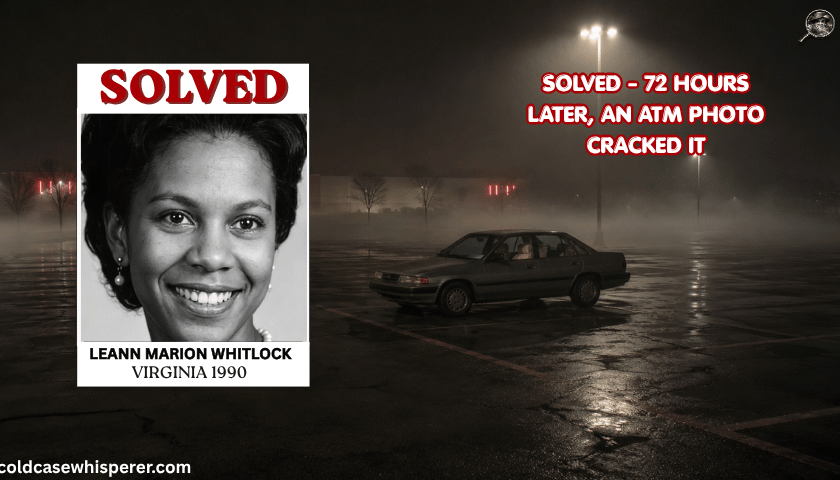
Leann Whitlock Murder: Solved Cold Case A Ride to Return a Favor
On the evening of January 5, 1990, a nineteen-year-old college sophomore left her Harrisonburg apartment to return a borrowed car to her boyfriend at the mall where he worked.
She never made it back. Six days later, her body was found in a cornfield twenty-five miles away. The Leann Whitlock case would result in convictions for both men responsible.
But it would also become one of the most significant death penalty cases in American legal history, reaching the United States Supreme Court nearly a decade after her murder.
Background
Leann Marion Whitlock was born on November 30, 1970, in Roanoke, Virginia. By January 1990, she was nineteen years old and a sophomore at James Madison University in Harrisonburg, a public university in the Shenandoah Valley with a student population that made the surrounding city feel busier and younger than its size might otherwise suggest.
She was studying psychology and was dating a fellow student named John Dean, who had a part-time job at the Valley Mall in Harrisonburg, a shopping center on the edge of town that served both the university community and the wider Rockingham County area.
On the afternoon of January 5, Leann borrowed Dean’s 1986 blue Mercury Lynx to run errands, with plans to return it to him at the mall that evening. She left her apartment around 6:30 or 6:45 p.m. She never arrived, and no one who knew her saw her alive again.
The Leann Whitlock Case Begins
That evening, two men, twenty-four-year-old Tommy David Strickler and twenty-three-year-old Ronald Lee Henderson, were in the Valley Mall parking lot looking for a car to steal. A mall security guard, Virginia Smith, had already been alerted that afternoon to two men matching their description who appeared to be attempting to break into a vehicle.
When Leann arrived to return the Lynx, a bystander named Anne Stoltzfus witnessed the abduction directly. She later testified that she saw Strickler pound on the car, yank the door open, and jump inside, and that she had noticed him earlier in the parking lot and sensed something was wrong. Henderson got in as well, and the men drove off with Leann still in the vehicle.
Roughly an hour or two later, another witness saw Strickler and Henderson driving the Lynx in a rural area of Augusta County. Later that same night, the two men went to a bar and dance hall, where they met a woman named Donna Kay Tudor and spent the evening drinking.
Tudor later told investigators that Strickler pulled out a hunting knife that night and made a racially charged threat, a detail that added a disturbing dimension to an already brutal crime, since Leann was Black and her killers were white.
Strickler and Henderson kept driving the stolen Lynx for several days before abandoning it. Tudor was later charged with larceny for her role in using the car during that time, though she was not charged in connection with the murder itself.
ALSO READ: 👉 More on forgotten Solved Cases Stories
The Investigation
Leann’s disappearance triggered an immediate search once her family and roommates realized she never returned home. Her roommates, Bethany Rogers and Sonya Lamb, told investigators they had last seen her leaving their apartment to return the car.
John Dean confirmed he had lent it to her that afternoon. Investigators quickly connected her disappearance to reports involving the two men seen near his car at the mall. About a week after the murder, Strickler was arrested.
Investigators recovered a bag from his mother’s house containing Leann’s identification cards and a shirt stained with blood and semen. Hair samples collected from the crime scene were later found to be consistent with Strickler’s.
On January 11, 1990, six days after she vanished, Leann’s body was discovered in a cornfield in Augusta County, roughly twenty-five miles from the mall, in a stretch of rural farmland far from the college town where she had spent her final ordinary afternoon.
She had died from blunt force injuries to her head. A sixty-nine-pound rock, along with bloody indentations in the ground nearby, was recovered at the scene and believed to be the murder weapon. At trial, Henderson gave a taped account claiming that Strickler alone struck the fatal blows in the cornfield, and that he had tried unsuccessfully to stop him.
Prosecutors called that account implausible, noting Henderson could not explain how the rock and the indentations in the ground came to be exactly where he described them if he had not been directly involved.
Henderson evaded arrest for six months before he was located in Oregon and extradited to Virginia to face trial. What the trial record makes clear is that Strickler and Henderson had not set out that afternoon looking for Leann specifically.
According to the evidence presented at trial, they had simply been scanning the Valley Mall parking lot for any car they could steal, and a security guard had already noticed them attempting to break into a different vehicle earlier that day.
Leann Whitlock happened to be the person who arrived at the wrong car at the wrong moment. That randomness, a theft that escalated into an abduction and then a killing, is part of what made the case so unsettling to the community around Harrisonburg at the time, and part of what has kept it studied in criminal justice circles ever since.
Watch the Full Story Unfold in Our Narrated Case Breakdown & Subscribe Too:
👇👇
Where the Case Stands
Strickler and Henderson were tried separately, prosecuted by Commonwealth’s Attorney A. Lee Ervin. At his trial, Strickler was convicted of capital murder, robbery, and abduction, and the jury recommended a death sentence, which the court imposed.
The judge who presided over Strickler’s trial recused himself from Henderson’s trial, saying he had already formed an opinion about what happened that night.
Henderson’s trial hinged on a narrower legal question: prosecutors needed to prove beyond a reasonable doubt that he had personally struck the blows that killed Leann, not simply that he participated in her abduction.
His attorney, Humes Franklin Jr., argued the evidence did not establish that Henderson delivered the fatal injuries. The jury convicted him of first-degree murder rather than capital murder, along with robbery and abduction, and recommended three consecutive life sentences, which the court imposed.
Leann’s mother, Esther Whitlock, who had earlier identified her daughter’s watch and earrings for the jury, said afterward that the family would have to accept the verdict, though it would be difficult to ever put the loss behind them.
Strickler’s case did not end with his conviction. His attorneys later discovered that prosecutors had withheld documents and interview notes that could have been used to challenge the credibility of Anne Stoltzfus, the witness who identified him as the one who forced Leann into the car.
The withheld material reportedly included information that could have undercut portions of her account. Strickler argued this violated his right to a fair trial under Brady v. Maryland, the Supreme Court precedent requiring prosecutors to turn over evidence favorable to the defense.
The case worked its way through the federal courts for years, first through a habeas corpus petition in Virginia state court, then through the federal district and appeals courts, ultimately reaching the United States Supreme Court as Strickler v. Greene.
In its 1999 ruling, the Court agreed that prosecutors should have disclosed the material relating to Stoltzfus but found that, even without her testimony, the remaining evidence against Strickler, including the physical evidence recovered from his mother’s house.
The hair samples and the accounts of other witnesses who placed him at the mall and later near the cornfield were strong enough that the nondisclosure did not undermine confidence in the verdict. Brady v. Maryland, the case Strickler relied on, had established decades earlier that a prosecutor’s failure to turn over favorable evidence violates due process, but courts had long wrestled with how serious that failure needs to be before it requires a new trial.
The ruling in Strickler v. Greene became a significant precedent defining exactly that standard, and it is still studied in law schools today as one of the defining cases on prosecutorial disclosure obligations. Strickler pursued a clemency petition and further appeals in the years that followed, maintaining his innocence, but none succeeded.
Tommy Strickler spent nine years on death row before he was executed by lethal injection on July 21, 1999, at the Greensville Correctional Center in Jarratt, Virginia. A spokesman for the Virginia Attorney General’s office said at the time that he hoped the ruling would close out a decade of legal proceedings for Leann’s family. Ronald Henderson remains incarcerated, serving his three consecutive life sentences.
The Leann Whitlock case remains a point of reference in legal discussions of prosecutorial disclosure obligations, cited in law schools and court opinions long after her death. For her family, the case’s legal legacy has never changed the underlying fact of what was lost: a nineteen-year-old college student who left her apartment on an ordinary January evening to do a favor for her boyfriend and never came home.
Her murder, and the trial and appeals that followed, remain one of the more consequential true crime cases to come out of the Shenandoah Valley, both for the tragedy itself and for the legal questions it left behind about what a fair trial requires.
For the full narrated version of this case, told documentary-style, visit the Cold Case Whisperer YouTube channel.
Sources
This account draws on the United States Supreme Court opinion in Strickler v. Greene (527 U.S. 263, 1999), the federal district court opinion in the same case, Wikipedia’s documented case summary, contemporaneous trial coverage from the Roanoke Times, and Washington Post reporting on the 1999 Supreme Court ruling and execution.
One comment