
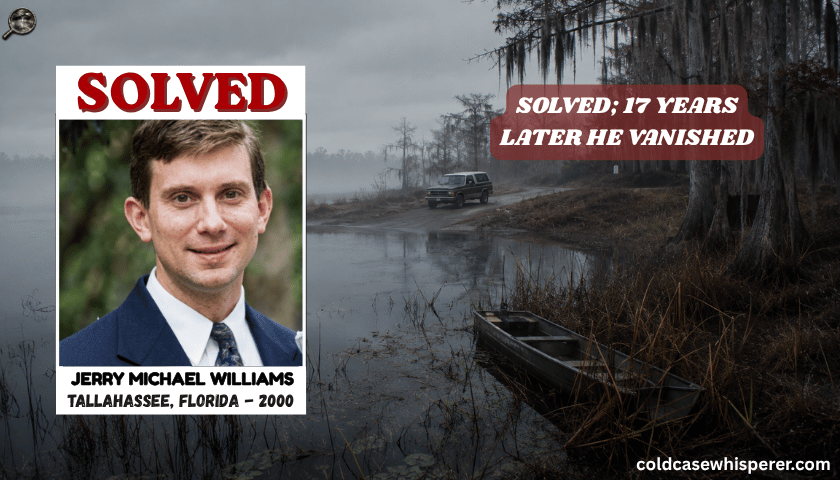
Jerry Mike Williams Case – A Duck Hunting Trip That Never Ended
On the morning of December 16, 2000, a thirty-one-year-old real estate appraiser drove to a lake outside Tallahassee, Florida, for a solo duck hunt. He never came home. For seventeen years, his disappearance was treated as a tragic accident, a man lost to the water and possibly an alligator.
The Mike Williams case would eventually prove to be something far darker: a murder plotted by his wife and his best friend, hidden for nearly two decades until a separate crime forced the truth into the open.
Background
Jerry Michael Williams, known to everyone as Mike, was born on October 16, 1969, in Tallahassee, Florida, and grew up in nearby Bradfordville, the son of a Greyhound bus driver and a daycare provider who raised him and his older brother in a double-wide trailer.
He attended North Florida Christian School, where he became close friends with Brian Winchester and met his future wife, Denise Merrell. The four of them, Mike, Denise, Brian, and Brian’s then-girlfriend Kathy, moved in the same tight social circle through high school, forming two couples who stayed connected into adulthood.
Mike went on to Florida State University and built a career as a real estate appraiser with Ketcham Realty and Appraisal Group, where he worked from age eighteen until the day he vanished, well liked by his boss, Clay Ketcham, and known among friends as an avid hunter and fisherman.
Mike and Denise married in 1994. By 2000, they had a young daughter, Anslee, and lived in a home on Centennial Oaks Circle in Tallahassee. To the people around them, it looked like a stable, happy marriage between two high school sweethearts.
The Mike Williams Case Begins
On December 16, a Saturday, Mike left home before dawn with his boat in tow, heading for Lake Seminole on the Florida-Georgia line for a duck hunting trip. The day carried extra weight; it was Mike and Denise’s sixth wedding anniversary, and he had promised to be back by noon so they could leave for a getaway in Apalachicola.
Noon came and went with no word from him. By evening, Denise had contacted his family and friends, and a search party formed, including Mike’s father and Brian Winchester. That night, searchers found Mike’s small motorized boat abandoned along the shoreline and his truck parked nearby. There was no sign of him, no blood, no indication of a struggle.
Investigators settled on the theory that Mike had drowned after his boat struck a submerged stump, his heavy waders filling with water and dragging him under.
When a search of the lake bed turned up nothing, the working explanation shifted to something grimmer: that an alligator had taken his body. Mike’s mother, Cheryl Williams, never accepted either explanation. She spent the next seventeen years pushing law enforcement to reopen the case, writing letters to Florida’s governor and refusing to let her son’s file go cold.
In 2004, the Florida Department of Law Enforcement took over the investigation from the Jackson County Sheriff’s Office, sharing her suspicion that the accepted story didn’t add up. FDLE agents and analysts logged more than three thousand hours on the case in the years that followed, though it remained unsolved for another twelve years.
ALSO READ: 👉 Leann Whitlock Case: Solved Cold Case That Reached the Supreme Court, Virginia 1990
The Investigation
The break came in 2016, not from new forensic evidence but from an unrelated crime. By then, Brian Winchester and Denise had married in December 2005, five years after Mike’s disappearance, but the relationship had deteriorated, and they separated in 2012 and divorced in 2016.
That August, Winchester forced his way into Denise’s car at gunpoint and held her against her will for about an hour. He pleaded no contest to kidnapping and was sentenced to twenty years in prison.
Facing that sentence, Winchester made a decision that unraveled the entire case. In October 2017, he signed a proffer agreement with the State Attorney’s Office granting him full immunity from prosecution for Mike’s death in exchange for a truthful confession and cooperation in locating his remains.
State Attorney Jack Campbell later said he believed the deal was the only way the case would ever be solved. Winchester then described, in detail, how he and Denise had spent months planning to stage Mike’s death as a hunting accident.
On the morning of December 16, he met Mike at the lake as planned, and once they were out on the water, he pushed him overboard, expecting his waders to drag him under. Instead, Mike surfaced and grabbed onto a submerged stump, fighting to stay alive.
Winchester then shot him once in the face with a twelve-gauge shotgun. He drove the body back toward Tallahassee and buried it in a shallow, muck-filled grave near a boat landing not far from where Mike had grown up.
Following Winchester’s confession, investigators located Mike’s remains in the fall of 2017, buried under muck near a boat landing not far from where he had grown up. DNA testing confirmed the identification, and on December 20, 2017, the day after Winchester was sentenced in the kidnapping case, the Florida Department of Law Enforcement publicly announced what had happened.
Mike Williams had not drowned and had not been eaten by an alligator. He had been murdered. Clay Ketcham, Mike’s longtime boss and friend, told the Tallahassee Democrat he never thought the day would come, calling it horrible but also a relief to finally reach some resolution after so many years of not knowing.
Watch the Full Story Unfold in Our Narrated Case Breakdown & Subscribe Too:
👇👇
Where the Case Stands
With Winchester’s account in hand, investigators turned to Denise Williams. On May 8, 2018, nearly eighteen years after Mike disappeared, she was arrested and charged with first-degree murder, conspiracy to commit murder, and accessory after the fact.
Prosecutors argued that Denise and Winchester had been having an affair since 1997, three years before the murder, and that they conspired together to kill Mike so they could be together and collect on the roughly $1.75 million in life insurance policies he carried, one of which Winchester himself had sold him just six months before his death.
Her defense argued she had no knowledge of the plot and that Winchester, a confessed killer testifying under an immunity deal, had every reason to implicate her falsely.
At trial in December 2018, jurors heard Winchester describe the affair and the murder in detail. He had known Denise since high school, and their romance, he testified, began in 1997 and deepened over the following years even as both remained married to other people.
On the witness stand, he described himself and Denise as having been “partners in crime” during those years, drawing an explicit comparison to Bonnie and Clyde. Prosecutors paired his testimony with corroborating evidence, including the insurance payout Denise collected after successfully petitioning to have Mike declared dead in 2001.
Personal letters connecting her to the years-long affair, and photographs from a trip the two couples took together before the murder. Denise’s attorney, Ethan Way, argued throughout the trial that she had nothing to do with the plot, that she had believed the same drowning story everyone else did.
And that the only evidence against her came from a confessed killer who had been granted immunity and had every incentive to shift blame. On December 14, 2018, the jury convicted her on all three counts. She was sentenced in February 2019 to life in prison without parole on the murder charge, plus thirty years for conspiracy.
The case took another turn in November 2020, when Florida’s First District Court of Appeal reversed her first-degree murder conviction. The three-judge panel ruled that under Florida law, being present for or benefiting from a murder is not the same as actively aiding or abetting it, and found that the evidence did not establish Denise had done anything to directly help Winchester carry out the killing itself, as opposed to agreeing to the plan beforehand.
The court upheld her conspiracy conviction on separate grounds, finding the evidence clearly showed she and Winchester had agreed in advance that he would kill Mike, reissuing a fuller opinion explaining its reasoning in March 2021.
She was resentenced on September 9, 2021, to thirty years in prison for conspiracy to commit murder, a sentence she is currently serving. Brian Winchester, the man who confessed to pulling the trigger, was never charged with Mike’s murder because of the immunity agreement that led investigators to his remains.
He remains in prison serving his twenty-year sentence for kidnapping Denise. Cheryl Williams, whose seventeen years of persistence were widely credited with keeping the case alive long enough to be solved, continues to live in Florida.
The case has since drawn national attention well beyond Tallahassee. It was featured on an episode of the Cold Case Files series, which focuses on the small fraction of cold cases that are eventually solved, and later became the subject of the Hulu documentary “Mr. and Mrs. Murder” and the ABC News Studios series “Mr. & Mrs. Murder,” both built around interviews with people close to the case.
The comparisons to the 1944 film noir “Double Indemnity,” in which an insurance man helps his lover kill her husband for a payout, were made repeatedly by reporters covering the trial, and the parallel was hard to miss: Winchester had literally sold Mike the policy that later financed the life he and Denise hoped to build together.
For the full narrated version of this case, told documentary-style, visit the Cold Case Whisperer YouTube channel.
Sources
This account draws on reporting from CBS News, ABC News, the Tallahassee Democrat as cited by regional outlets including WCTV and WTXL, the Florida First District Court of Appeal’s opinion in Williams v. State, and Wikipedia’s documented case summary.
One comment