
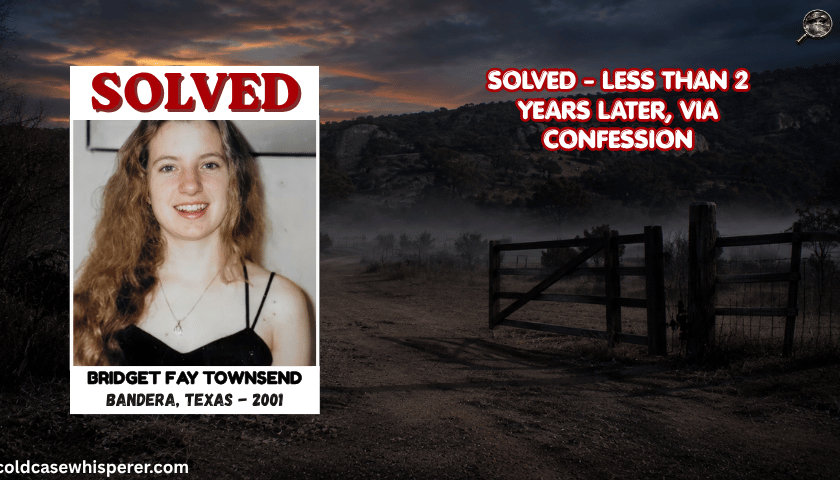
Bridget Townsend Solved Case – A Debt Paid on Her Birthday
On June 26, 2024, the State of Texas executed the man who murdered eighteen-year-old Bridget Townsend. He was pronounced dead at 6:50 that evening. It was Bridget’s birthday. She would have turned forty-two.
The Bridget Townsend case took more than two decades to resolve, moving from a missing persons report in rural Texas to a capital murder conviction to an execution that landed, by coincidence, on the exact date she was born.
Background
Bandera County sits in the Texas Hill Country, a region of ranch land and limestone hills where distances between neighbors are often measured in miles rather than blocks.
In a place like that in the early 2000s, a missing eighteen-year-old could slip out of the public record with unsettling speed if the wrong combination of silence and geography worked against her. That was the setting Bridget Townsend disappeared into.
Bridget Fay Townsend was born on June 26, 1982, in Houston, Texas. By January 2001, she was eighteen and living in Bandera County, in the Texas Hill Country northwest of San Antonio, where she was in a relationship with a young man named Joe Leal. Leal later described himself as having dealt drugs out of the home he shared with Bridget.
Public information about her life beyond the circumstances of her death is limited, but what is known paints a picture of an ordinary young woman building toward something: she worked full time at a resort in the Hill Country and had applied to nursing school, waiting to hear back when her life was cut short.
Her mother, Patricia, later described her as someone who loved people and made a point of hugging anyone she hadn’t seen in a while.
On the evening of January 15, 2001, Bridget spoke with Leal by phone, telling him she needed to get up early for work the next day and mentioning that eighteen-year-old Ramiro Gonzales, whom Leal knew as a buyer, had stopped by the house earlier that day.
When Leal came home after midnight, the house was cold, Bridget wasn’t in bed or on the couch, and a box where he kept two to three hundred dollars in cash had been emptied. He reported her missing the next day, January 16.
The Bridget Townsend Case Begins
According to court records and Gonzales’s later account, he had gone to Leal’s home that day intending to steal cocaine. Leal wasn’t there, but Bridget was. Gonzales took the cash from the house, and when Bridget tried to call Leal to tell him what was happening.
Gonzales overpowered her, tied her up, and drove her to his family’s ranch in neighboring Medina County. There he sexually assaulted her and shot her to death, then left her body in a remote field and went home as though nothing had happened.
With no body, no confession, and no suspect connected to Bridget, the case moved slowly, typical for a rural jurisdiction working a missing persons case without a crime scene. Investigators had no reason at the time to look at Gonzales, who was known to Leal but not otherwise connected to Bridget in any way that stood out.
Eight months later, in September 2001, Gonzales abducted and raped a real estate agent in the Bandera area. She survived and later testified that she believed she would have been killed had she not escaped. That case led to his arrest, and in 2003 a jury convicted him of abduction and rape, sentencing him to two consecutive life terms.
ALSO READ: 👉 Mike Williams Drowning: Solved Cold Case After a Faked Drowning, Florida, 2000
The Investigation
Bridget’s case remained unsolved for nearly two years after she vanished. The break came in 2002, while Gonzales was in the Bandera County jail awaiting transport to state prison on the abduction and rape conviction.
He asked to speak with Bandera County Sheriff James MacMillian and told him he could show him where Bridget’s remains were. According to his later clemency petition, Gonzales had first admitted what he’d done during an interview with a television news reporter before that conversation with the sheriff, though the accounts of exactly how his confession first surfaced vary slightly.
With Gonzales riding along, the sheriff followed his directions to the family ranch in Medina County. About a hundred yards into a remote section of the property, they found a human skull roughly ten feet from where Gonzales said he had left her. Her remains were recovered in October 2002, nearly two years after she disappeared.
With Gonzales’s confession and the recovery of Bridget’s remains, Texas prosecutors moved forward with a capital murder case. A Medina County jury heard the case in 2006. Because Texas requires capital juries to determine not just guilt but whether a defendant poses a continuing danger to society, prosecutors called psychiatrist
Dr. Edward Gripon, who testified that Gonzales showed a pattern of controlling and manipulating others and would likely remain dangerous. The jury convicted him of capital murder and sentenced him to death. At not yet twenty-four years old, he became one of the youngest people on death row in the country at the time.
Watch the Full Story Unfold in Our Narrated Case Breakdown & Subscribe Too:
👇👇
Where the Case Stands
Gonzales’s case moved through the appeals process for close to two decades, a span not unusual for capital cases in the United States. He had at least one earlier scheduled execution date going back to 2016 that did not proceed.
In November 2021, a separate execution was delayed over an unrelated legal dispute in Texas concerning whether a death row inmate’s spiritual advisor could pray aloud or touch the inmate during the execution itself. He received another stay in 2022.
Every time the case returned to court, whether for a routine appeal, a stay of execution, or a clemency hearing, it pulled Bandera and Medina counties back into headlines that small rural communities in the Texas Hill Country rarely see.
Bridget’s brother, David Townsend, became the family’s most visible public voice during those years, opposing efforts to spare Gonzales and describing what he had done to his sister in blunt terms. He argued publicly that the 2006 sentence should be carried out, and in a statement released around the time of the execution said the family wasn’t seeking revenge but closure, a peace made harder to reach by how long the case had stayed in the public eye.
In the years that followed, Dr. Gripon, the same psychiatrist whose testimony had helped send Gonzales to death row, met with him and reversed his original assessment, concluding Gonzales was not the continuing danger he had once predicted.
That reversal became central to a clemency petition filed by Gonzales’s attorney, which described a childhood marked by exposure to drugs before birth, abuse, and abandonment. According to the petition, Gonzales’s mother used drugs while pregnant with him and gave him up shortly after birth, leaving him to be raised primarily by his grandmother.
He was reportedly sexually abused as a child by a male relative, dropped out of school after seventh grade, was using drugs and alcohol regularly by age twelve, and did not meet his own father until he was nineteen, in a county jail.
Before his arrest, he had worked as a welder and fence builder. His attorneys argued that during his years on death row he had undergone genuine change, devoting himself to religious study and, according to reporting at the time, offering to donate a kidney to a stranger.
On June 24, 2024, the Texas Board of Pardons and Paroles considered that petition and voted against clemency. Two days later, on June 26, 2024, his birthday, Gonzales was executed by lethal injection at the Walls Unit in Huntsville. In his final statement, he apologized directly to Bridget’s family and said he had never stopped praying they would forgive him. He was pronounced dead at 6:50 p.m.
Bridget’s mother, Patricia, told reporters afterward that while others had come to see a changed man, she saw only the man who had taken her daughter’s future. Her brother, David, said the family had finally witnessed justice being carried out, calling it the end of a long and painful road, though he was careful to note the family wasn’t celebrating.
Advocacy groups opposed to Gonzales’s execution had campaigned for clemency in his final months, reportedly gathering more than twenty thousand signatures asking Governor Greg Abbott to intervene. The campaign did not change the outcome.
The Bridget Townsend case became part of a broader debate in Texas over whether the legal system should weigh who a person becomes in prison against what they did before they arrived there. Some pointed to Gonzales’s documented change, his religious conversion, the kidney donation offer, and the reversed opinion of the very psychiatrist who had helped convict him.
As reasons, his execution served little purpose beyond the crime itself. Others, including Bridget’s own family, argued that whatever Gonzales became in his final years on death row did not return Bridget to them or undo what he did to her in January 2001.
The case also sits inside a specific legal detail: the U.S. Supreme Court’s 2005 ruling in Roper v. Simmons barred executing anyone for a crime committed before age eighteen. Gonzales had turned eighteen only months before he killed Bridget, placing him on the side of that line that still permitted a death sentence.
Had the crime happened even slightly earlier in his life, the legal path of the entire case would have looked different from the start.
For nearly two years after Bridget disappeared, her case sat open but effectively frozen; without a body there was no forensic starting point, and without a suspect there was no name to build a case around. It was Gonzales himself, already behind bars for an unrelated crime, who finally supplied both.
For more than two decades after that, Bridget Townsend’s name appeared mostly in court filings and news updates marking another stage in her killer’s path through the legal system. She was eighteen, working toward a career in nursing, and known for hugging the people she loved. Everything documented in her case exists only because that life was taken from her.
For the full narrated version of this case, told in a documentary style, visit the Cold Case Whisperer YouTube channel.
Sources
This account draws on the official Texas execution report for Ramiro Gonzales, Wikipedia’s documented case summary, contemporaneous reporting from Texas Public Radio, Houston Public Media, and NBC News on the 2024 execution, and reporting on Gonzales’s clemency petition from the Associated Press via Yahoo News.
One comment