
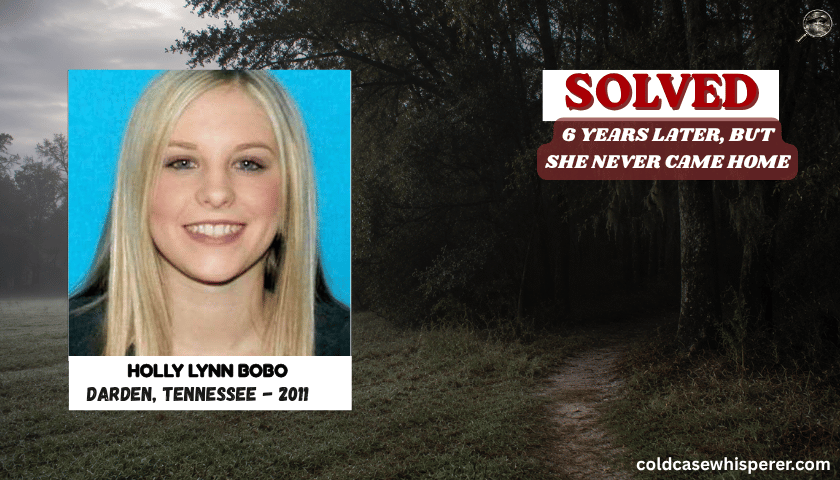
Holly Bobo Cold Case: A Morning That Ended in the Woods
Just before eight in the morning on April 13, 2011, Clint Bobo woke up to the sound of the family dogs barking outside his home near Darden, Tennessee. He looked out to see his sister Holly kneeling in the garage, talking with a man dressed in camouflage.
He assumed the man was her boyfriend and went back to what he was doing. Minutes later, his mother called from work, having just heard that a neighbor reported a scream from the house. By the time Clint reached the garage, there was blood on the floor, and his sister was gone.
The Holly Bobo case would take more than three years to produce an arrest, six and a half years to reach trial, and remains legally contested to this day.
Background
Holly Lynn Bobo was twenty years old in April 2011, a nursing student at the University of Tennessee at Martin’s Parsons Center, living with her family in Darden, a small, rural community in west Tennessee. She was close with her parents, Karen and Dana Bobo, and her older brother Clint, with whom she shared the family home.
Those who knew her described a shy, caring young woman with an ordinary, hopeful path ahead. On the morning she disappeared, Holly had woken at 4:30 a.m. to study for an exam. Her parents left for work by 7:30.
Around that time, her boyfriend, Drew Scott, called to say he was turkey hunting on her grandmother’s nearby property. She made her last outgoing call twelve minutes later, at 7:42. Sometime after that, a neighbor heard a scream from the direction of the Bobo home.
The Holly Bobo Case Begins

By the time Clint understood something was wrong and called 911, Holly and the man in camouflage were gone, last seen heading up a trail into the woods behind the property. Police arrived within ten minutes, and the Tennessee Bureau of Investigation later confirmed the blood found in the garage matched Holly’s DNA.
What followed was one of the largest search operations in Tennessee law enforcement history. The TBI, the FBI, and hundreds of volunteers combed the wooded terrain around the Bobo property for weeks, searching areas that became familiar names throughout the investigation:
Bible Hill, Yellow Springs, Gooch Road, and Horney Head Creek. A lunchbox believed to belong to Holly turned up near Bible Hill Road within days, and investigators later recovered other items, including a SIM card and a receipt, along routes north of Darden.
Community prayer vigils drew large crowds within the first week, and missing person posters bearing her photograph remained a fixture around the region for years, a quiet reminder to everyone who passed them that a young woman from their own community was still unaccounted for.
ALSO READ: 👉Bridget Townsend Case: Solved Cold Case Ending on Her Birthday, Texas, 2001
The Investigation
Despite the scale of the search, the case struggled for years to move beyond Clint’s description of an unidentified man in camouflage. One early name of interest was Terry Britt, a registered sex offender living near the Bobo family with a documented history of stalking women matching Holly’s description, blonde hair and blue eyes.
Investigators found his alibi weak, and a cousin reported Britt had been seen staring at the family in the days before Holly vanished. Holly’s mother reportedly urged investigators to look closely at him. The lead investigator at the time said publicly he didn’t believe the abduction was a crime of passion.
But something planned, a theory he believed pointed toward Britt’s documented pattern rather than a spontaneous group crime. Despite years of scrutiny, Britt was never charged in connection with the case. Under the law, he must be regarded as never having been proven responsible for anything related to it.
In 2013, a pink purse found along Myracle Town Road briefly raised hopes that physical evidence had finally surfaced. Karen Bobo examined it and confirmed it wasn’t her daughter’s, one of many false leads the family endured over nearly three years of uncertainty.
The case moved forward in early 2014. Notably, Zachary Adams, who would eventually be convicted of Holly’s murder, had already crossed paths with law enforcement just nine days before she disappeared, arrested by park rangers at Natchez Trace State Park on charges including evidence tampering and resisting arrest.
On February 28, 2014, investigators executed a search warrant at Adams’s home. Days later, his brother, John Dylan Adams, was arrested on unrelated charges. During questioning, Dylan told investigators he had gone to Zach’s home that day and witnessed Zach, then wearing camouflage, with Holly present, and that Zach later told him he had raped and killed her and recorded it on video.
That alleged recording has never been found. Zachary Adams, then twenty-nine, was arrested and charged with aggravated kidnapping and first-degree murder.
A third man, Jason Autry, became central to the case in the months that followed. He agreed to plead guilty and testify against Adams, and it was his account, describing how the men abducted Holly and how he personally helped move her body afterward, that formed the backbone of the prosecution’s case.
A fourth man originally investigated, Shayne Austin, died in 2015 before the case ever reached trial. The case’s original lead TBI investigator later testified that he had cleared Adams, Autry, and Austin early in the investigation, before the case against Adams was eventually rebuilt around Autry’s cooperation and Dylan’s statement.
Holly’s remains were discovered on September 7, 2014, by ginseng hunters in a wooded area of northern Decatur County, roughly twenty miles from Darden and less than six miles from Adams’s property. Investigators confirmed the identification the following day. Forensic examination was limited by more than three years of exposure to the elements.
Adams’s trial began in September 2017 in a Tennessee courtroom that drew heavy statewide coverage. No DNA or fingerprint evidence was ever presented linking him to Holly or to where her remains were found; the case rested substantially on Autry’s testimony.
On September 22, 2017, a jury convicted Adams of first-degree felony murder, especially aggravated kidnapping, and aggravated rape. Inside the courtroom, the family’s pastor led a prayer of relief once the verdict was read.
Minutes before the sentencing phase, in which the jury would have considered the death penalty, Adams accepted a deal for life without parole plus fifty consecutive years. At sentencing, Karen Bobo addressed the court directly, describing her daughter as someone who appreciated the small things in life and calling her the sweetest soul she had ever known.
Dylan Adams later entered an Alford plea in January 2018 to facilitation of murder, receiving thirty-five years. Autry was not prosecuted for his role in Holly’s death in exchange for his cooperation, though he was later sentenced separately to federal prison on unrelated weapons charges.
Where the Case Stands
Adams’s conviction has faced repeated challenges since 2017. On September 9, 2022, the Tennessee Court of Criminal Appeals upheld it, rejecting every argument his attorneys raised.
The more serious threat came afterward: at some point, Autry gave a recorded, unsworn interview stating that he had lied during his original testimony and had worked with a defense investigator to build a false account that put an innocent man in prison. That video, obtained and reported by a Tennessee news station in 2024, became the basis for Adams’s petition for post-conviction relief.
An evidentiary hearing began in May 2025 before Hardin County Circuit Judge J. Brent Bradberry. Autry, back in prison on unrelated charges, invoked his Fifth Amendment right and refused to testify.
Judge Bradberry ruled the video of his recantation inadmissible as hearsay, citing that the interview lacked the solemnity of sworn testimony, that Autry said he had been under the influence of drugs during it, and that he was now refusing to testify about it under oath.
The hearing, recessed and resumed multiple times, included testimony from a retired TBI agent and from Adams’s original trial attorney, Jennifer Thompson, who described being the only attorney handling the defense and feeling overwhelmed by the circumstances of the trial.
Adams himself testified for the first time, denying any relationship with Holly beyond her mother having been his fourth-grade teacher, and denying he had ever admitted to killing her. His defense pointed to ATM drive-thru footage allegedly showing Adams, his brother, and a third man withdrawing money around 11 a.m. the day Holly disappeared, arguing it supported an alibi.
The presiding judge found no one could actually be identified in that footage. Closing arguments concluded in December 2025.
On July 17, 2026, Judge Bradberry issued a 97-page ruling denying Adams’s petition for a new trial, finding insufficient support for claims of an alternative suspect and that his attorneys had failed to meet the legal standard required to prove ineffective counsel.
TBI Director David Rausch said the agency welcomed the decision. The Bobo family, through a spokesperson, said the ruling didn’t erase their loss but that knowing the verdict had been upheld again brought them some measure of peace.
Adams’s conviction stands today, tested through direct appeal, appellate review, and an extensive post-conviction hearing. At the same time, it remains accurate that no physical evidence has ever publicly linked him to the crime scene, and that the case rested substantially on testimony from co-defendants with strong incentives to cooperate.
And that one of those witnesses later said, outside of a courtroom, that his testimony was not truthful. Both of those things are part of the documented record, and reasonable people who have followed the case closely have weighed them differently.
More than fifteen years after that April morning, Holly Bobo is remembered by those who loved her as a young woman on her way to becoming a nurse who never came home.
For the full narrated version of this case, told documentary-style, visit the Cold Case Whisperer YouTube channel.
Sources
This account draws on Tennessee Bureau of Investigation case records, contemporaneous news coverage from NewsChannel5, NBC News, and Court TV’s ongoing coverage of the 2025-2026 post-conviction hearing, and reporting from WBBJ and Action News 5 on Judge Bradberry’s July 2026 ruling.