
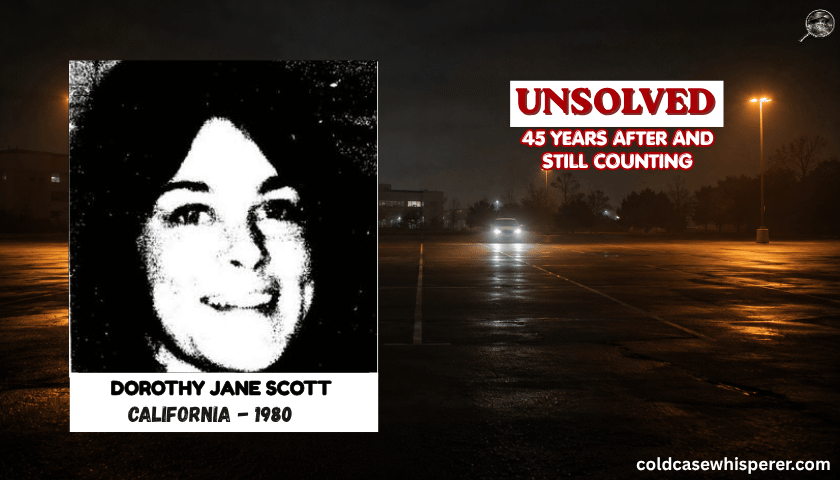
Dorothy Jane Scott Case – A Car That Never Came Back
On the night of May 28, 1980, two coworkers stood in a hospital parking lot in Orange, California, waiting for a woman named Dorothy Jane Scott to bring the car around.
They watched headlights swing toward them, then swerve away into the dark, accelerating out of the lot before either man could see who was behind the wheel. She never came back.
The Dorothy Jane Scott case has remained unsolved for more than four decades, built around a series of taunting phone calls, a burned car, and a killer who was never identified.
Background
Dorothy Jane Scott was born on April 23, 1948. By the spring of 1980, she was thirty-two, a single mother raising her four-year-old son, Shanti, sometimes called Shawn. She lived in Stanton, California, with her aunt, about 20 minutes from Anaheim, where her parents, Jacob and Vera Scott, lived.
She worked as a secretary for two adjoining Anaheim businesses, a shop called Swingers and a head shop called Custom John’s, both jointly owned by a man named John Kocyla. The businesses had once belonged to her father, who still worked there as a handyman.
People who knew Dorothy described her consistently: quiet, religious, not a drinker, rarely dating, and happiest at home with her son. The boy’s father, Dennis Terry, was not a regular presence in the household and was quickly ruled out by investigators, who confirmed he was in Missouri at the time she disappeared.
Beginning in early 1980, Dorothy started receiving anonymous phone calls at work from a man who alternated between declaring his love for her and threatening her life. On one occasion, he directed her to go outside, where she found a dead rose left on her windshield.
On another, he told her that when he got her alone, he would cut her into pieces so no one would find her. Frightened, Dorothy considered buying a gun and instead enrolled in karate classes. No one, including police, was ever able to identify the caller.
It is worth understanding how limited the tools available to Dorothy and to investigators actually were in 1980. There was no caller identification on home or business telephones. A person receiving threatening calls from a stranger had no way to see a number on a screen, and no way to know who was speaking unless the caller chose to reveal himself.
Stalking was not yet a defined crime anywhere in the country either. California would not pass the nation’s first anti-stalking law until 1990, a decade after Dorothy disappeared, a change prompted partly by a string of cases in which women who had reported being harassed were later killed by the same men who had threatened them.
The Dorothy Jane Scott Case Begins
On May 28, 1980, Dorothy attended a routine meeting at work. A coworker named Conrad Bostron began feeling unwell during the meeting, and Dorothy noticed an unusual mark on his arm. Concerned, she and another coworker, Pam Head, drove him to UCI Medical Center in Orange, where doctors determined he had been bitten by a black widow spider. He was treated and released around eleven o’clock that night.
Dorothy told her coworkers she would retrieve the car so they wouldn’t have to walk far in the dark, and walked out into the parking lot alone.
Her coworkers saw a car they believed was her white 1973 Toyota station wagon approach, headlights blinding them, before it turned sharply and sped away without stopping. Neither of them could see who was driving, or whether Dorothy was still inside. After roughly an hour with no sign of her, they called police, and the report reached officers in the earliest hours of May 29, 1980.
Hours later, Santa Ana police found Dorothy’s station wagon on fire in an alley roughly ten miles from the hospital. It was empty. Combined with the months of threatening calls she had received, investigators treated her disappearance as a probable abduction from the start, though they had almost nothing to work with beyond a voice on the phone and an unidentified figure behind a windshield.
This was an era before DNA testing existed in any usable form for criminal investigations, before cell phones could be tracked, and before security cameras were a routine fixture of hospital parking lots.
Fingerprint analysis existed, but a car that had burned in an alley for hours before it was discovered offered detectives very little intact surface to work from. Blood typing existed too, but it could only narrow a pool of suspects rather than identify one person the way DNA testing would decades later.
ALSO READ: 👉 The Sherri Jarvis Case: Unsolved Cold Case, Named After 41 Years | Texas 1980
The Investigation
For weeks the case had no significant break. Dorothy’s parents, working with police, took her story to the Orange County Register and offered a twenty-five-thousand-dollar reward for information. On June 12, 1980, the same day the paper published a story on the case, an unidentified man called the newsroom and reached managing editor Pat Riley.
The caller said he had killed Dorothy after catching her cheating on him, a claim she had denied. He included two details that had never been made public: that a coworker had been bitten by a spider the night Dorothy vanished, and that she had changed her scarf before arriving at the hospital. Investigators took this as strong evidence the caller had direct knowledge of what happened to her that night.
The calls didn’t stop there. Beginning about a week after Dorothy disappeared and continuing for roughly four years, her mother Vera began receiving calls at home, almost always on Wednesday afternoons when she happened to be alone.
Sometimes the caller simply asked if she was related to Dorothy Scott, then said “I’ve got her” and hung up. Other times he told her outright that he had killed her daughter. Police placed a recording device on the family’s phone line, but the caller never stayed on long enough to be traced.
In April 1984, Dorothy’s father happened to answer the phone instead of her mother for the first time. The calls stopped after that.
Four months later, on August 6, 1984, construction workers clearing land near Santa Ana Canyon Road in the Anaheim Hills area found partial skeletal remains roughly thirty feet off the road, in an area that had also been affected by a brush fire at some point in the intervening years.
Investigators used dental records, along with a distinctive turquoise ring Dorothy had regularly worn, to confirm the remains were hers. Because of how long the remains had been exposed to the elements, the coroner’s office could not determine an exact cause of death.
Watch the Full Story Unfold in Our Narrated Case Breakdown & Subscribe Too:
👇👇
Where the Case Stands
No one has ever been arrested or charged in Dorothy Jane Scott’s disappearance and murder. Over the years, investigators and later journalists looked at several people connected to her life and workplace. One name that has surfaced repeatedly in later reporting is Mike Butler, a man reportedly infatuated with Dorothy who had a connection to her workplace through his sister.
Butler was never arrested or charged, and he has since died, meaning any suspicion attached to his name has never been tested in court. Under the law, he must be treated as never having been proven responsible for anything connected to Dorothy’s case.
Some true crime researchers have also pointed to a possible connection between Dorothy’s case and the unsolved disappearance of a woman named Patricia Jean Schneider, whose car was also found burned after she vanished. That connection has never been confirmed by investigators and remains an unproven theory rather than a fact.
Dorothy’s story later aired on the television series Cold Case Files, introducing it to a national audience, and it has continued to circulate through true crime podcasts and articles since, kept alive not by new evidence but by people who have refused to let it fade.
That kind of attention matters in cases like this one. Cold cases are sometimes solved not through new forensic technology alone but because renewed public interest eventually reaches someone who has held onto a piece of information for years without realizing its significance.
Her father, Jacob Scott, died in 1994 without learning what happened to his daughter. Her mother, Vera, who spent years dreading the ring of the phone on Wednesday afternoons, never knowing if it would be an ordinary call or the voice that had haunted the family since 1980, died in 2002, also without an answer.
Dorothy’s son grew up largely raised by his grandparents, inheriting a story about his mother that he was too young to remember firsthand, pieced together over the years from what relatives and later journalists could tell him.
The Orange County Sheriff’s Department continues to list the Dorothy Jane Scott case as an open homicide investigation. Dorothy’s disappearance did not happen in isolation. Orange County and the wider region of Southern California carried a heavy weight of unresolved violence through the late 1970s and into the 1980s.
A period when several serial offenders operated across the same freeways and suburbs where Dorothy lived and worked, some of them not identified for decades. A number of those cases have since been closed using genetic genealogy techniques that did not exist in 1980 and were still years away even when Dorothy’s remains were found in 1984.
Those breakthroughs are a genuine reason to think a case like hers is not beyond hope simply because it has stayed open for more than four decades. Advances in DNA analysis mean that if physical evidence from the original investigation still exists in an evidence locker somewhere in Orange County, there remains a real possibility the case could still be solved.
If you have information about the disappearance and murder of Dorothy Jane Scott, contact the Orange County Sheriff’s Department at 714-647-7000.
For the full narrated version of this case, told in a documentary style, visit the Cold Case Whisperer YouTube channel.
Sources
This account draws on the Orange County Sheriff’s Department’s official case summary, Wikipedia’s documented case history, and reporting and retrospective coverage from A&E Crime + Investigation, the Criminal podcast, and other true crime research on the case.