
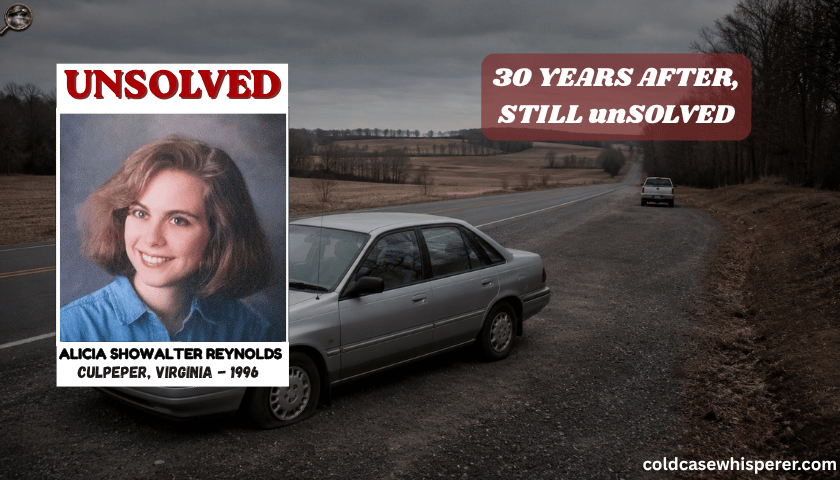
Alicia Showalter Reynolds Cold Case: A Drive That Never Ended
On a Saturday morning in March 1996, a young graduate student, Alicia Showalter Reynolds, left her home in Baltimore for what should have been an easy drive to meet her mother for a shopping trip in Charlottesville, Virginia.
She never arrived. Her car turned up hours later on the shoulder of U.S. Route 29, and two months after that, her remains were found in a field nearly fifteen miles away. Almost thirty years later, the Alicia Showalter Reynolds cold case remains open, with no arrest ever made.
Background
Alicia Showalter Reynolds grew up in Harrisonburg, Virginia, a graduate of Harrisonburg High School who went on to earn her undergraduate degree at Goshen College.
By 1996, she was twenty-five years old and working toward a doctorate in pharmacology at Johns Hopkins University School of Medicine in Baltimore, where she was part of a research team developing vaccines to fight bacterial diseases in developing countries.
Her father, Harley Showalter, would later describe her as focused and driven, someone who knew exactly what problem she wanted to solve.
She had married Mark Reynolds, a second-year dental student at the University of Maryland, on New Year’s Eve 1994, and the couple was living together in Baltimore. Her parents, Harley and Sadie Showalter, still lived in Harrisonburg, about two hours from Baltimore by car.
Those who knew Alicia described her as outgoing and active, someone who had built a full life around her research and her marriage in the year or so since the wedding. She had a twin brother, Patrick, who was finishing medical school around the same time she disappeared.
On the morning of Saturday, March 2, 1996, Alicia left her Baltimore home around 7:30 a.m. to drive roughly 150 miles to Charlottesville, where she planned to meet her mother for a day of shopping. Sadie had driven in from Harrisonburg. They had arranged to meet at a mall in Charlottesville. Alicia never showed up.
The Reynolds Cold Case Begins
After waiting more than an hour at the mall with no sign of her daughter, Sadie called Mark in Baltimore. He initially wondered if she might have been delayed, but as the day wore on with no word, he began calling police departments along the route between Baltimore and Charlottesville, worried she had been in an accident.
Investigators later pieced together a troubling sequence. Around 3:45 that afternoon, roughly five hours after Alicia is believed to have encountered her abductor, one of her credit cards turned up in the middle of a residential street in downtown Culpeper, as though it had been thrown from a moving vehicle.
Around 6 p.m., a passing motorist spotted her Mercury Tracer parked on the southbound shoulder of Route 29 in Culpeper County. A napkin had been left on the windshield, apparently meant to suggest the car had broken down.
When investigators inspected the vehicle, they found nothing mechanically wrong with it at all. The scene told a specific story: someone had used a fake car-trouble ruse, not an actual mechanical failure, to get Alicia to stop.
Witnesses came forward describing a white male, between thirty-five and forty-five years old, of medium build, standing near Alicia’s car close to a pickup truck.
Descriptions of the truck itself varied between witnesses; some recalled it as blue, while official releases in later years describe it as dark-colored, possibly a green Nissan, with the man himself put at five feet ten to six feet tall, with light to medium brown hair.
ALSO READ – The Buckskin Girl: How DNA Solved & Identified the Marcia King Cold Case
The Investigation
Once Alicia’s disappearance made headlines, several other women contacted police to describe strikingly similar encounters along the same stretch of Route 29 in Culpeper County, a man using a car-trouble story to get women to pull over, sometimes in the weeks or months before Alicia vanished.
The pattern was consistent enough that investigators, and eventually the public, began referring to the unidentified man as “the 29 Stalker.”
The Virginia State Police and FBI mounted an extensive search. Volunteers combed fields and wooded areas near where her car was found, roadblocks went up along Route 29, and tip lines took in calls from across the region. Composite sketches based on witness descriptions were circulated on television and in newspapers throughout central Virginia.
For weeks, the case dominated local news across Baltimore, Harrisonburg, and Charlottesville alike, three communities that all had a personal stake in finding her, and it drew national attention as the story of a missing graduate student on the verge of promising research took hold of public sympathy.
Mark Reynolds spent the weeks after Alicia’s disappearance working closely with investigators, retracing her route and answering questions about her routine and their marriage. Police cleared him early in the investigation, satisfied that his account of his own whereabouts that Saturday held up.
He would later tell reporters that the uncertainty of not knowing what happened to his wife was its own particular kind of torment, different from grief with a clear cause.
Investigators with the Virginia State Police and the FBI came to believe Alicia had been abducted by what one law enforcement source described as a sociopathic motorist, someone who presented himself as a polite good Samaritan and convinced her something was wrong with her car.
The roadside spot where her Mercury Tracer was found became an informal memorial in the weeks that followed, with flowers left along the shoulder and notes tucked among them from people who had never met her but had followed the story on the news.
On May 7, 1996, sixty-six days after Alicia vanished, turkey hunters came across skeletal remains in a field near the small community of Lignum, in Culpeper County, roughly fifteen miles from where her car had been found. The field had recently been cleared of trees.
State police used dental records to confirm the remains were Alicia’s. An autopsy could not determine an exact cause of death because of the advanced state of decomposition, but a forensic examination noted fractures to the ribs and pelvis consistent with violent trauma, and the manner of death was ruled a homicide.
The case, formally logged by Virginia State Police as case number 96-21498, left a lasting mark on the communities along the corridor. Reports of similar roadside encounters continued to surface for months afterward, and residents in Culpeper and the surrounding counties grew wary of stopping for strangers, even ones who appeared to be in genuine trouble.
Local officers spent months chasing down leads on pickup trucks registered in the area and cross-referencing them against men with histories of predatory behavior, without ever landing on a suspect who could be tied to the evidence.
Watch the Full Story Unfold in Our Narrated Case Breakdown & Subscribe Too: 👉 The Route 29 Unsolved Cold Case: Who Killed Alicia Showalter Reynolds? | True Crime | 1996, Virginia – 👇👇
Where the Case Stands
No one has ever been arrested or charged in connection with Alicia’s murder. Investigators did, at different points, look at potential connections to other men active in the region during that period. Officials at one point considered whether Richard Marc Evonitz, a serial killer operating in Virginia in the 1990s, could have been involved, though this was never confirmed and he was never charged in Alicia’s case before he died in 2002.
In 2002, following the arrest of Darrell David Rice in connection with a separate 1996 double murder in Shenandoah National Park, investigators also checked whether he might be tied to Alicia’s case. That link never materialized either.
A regional task force involving the Virginia State Police, the FBI, and other agencies examined whether Alicia’s murder might be connected to the 1996 killings of hikers Julianne Williams and Lollie Winans in Shenandoah National Park, but no forensic evidence has ever linked the cases.
Mark Reynolds continued to speak with reporters on anniversaries of Alicia’s disappearance for years afterward, holding onto hope that the case would be solved. He later remarried and moved to Houston.
Sadie and Harley Showalter have marked milestone anniversaries publicly, including the twentieth in 2016 and the thirtieth in 2026, continuing to ask anyone with information to come forward.
Virginia State Police say they have logged more than ten thousand tips over the nearly three decades since Alicia disappeared, and the case remains formally classified as an open, active homicide investigation. A reward has been offered over the years for information leading to an arrest.
The Alicia Showalter Reynolds case is one of several unsolved disappearances and killings of women associated with the Route 29 corridor in central Virginia during the 1990s. This pattern has never been definitively tied to a single perpetrator.
Advances in forensic testing have allowed investigators to revisit evidence collected from her car and from the recovery site, though state police have not disclosed whether any of that work has produced new leads.
The case is still frequently discussed alongside other unresolved disappearances tied to the Route 29 corridor between Charlottesville and the Washington, D.C. suburbs, a stretch of highway that gained an unwelcome reputation through the 1990s.
Sadie Showalter has said in interviews over the years that the not knowing never really lessens, that even decades later she still finds herself thinking about what her daughter’s life might look like today. She and Harley have used each anniversary, the fifth, the twentieth, the twenty-fifth, the thirtieth, to ask the public not to let Alicia’s case fade from memory.
Investigators have echoed that request, noting that a single overlooked detail, recalled by someone who was a child at the time or who never realized what they saw was significant, could still be the piece that moves the case forward.
If you have information about the disappearance or murder of Alicia Showalter Reynolds, contact the Virginia State Police Culpeper Division at 1-800-572-2260 or the Bureau of Criminal Investigation at 1-888-300-0156, or email bci.culpeper@vsp.virginia.gov.
Sources
This account draws on Virginia State Police case releases and public statements, contemporaneous reporting from The Baltimore Sun (1996 to 2002), and retrospective coverage from regional Virginia news outlets marking the case’s twentieth, twenty-fifth, and thirtieth anniversaries.
For the full narrated version of this case, told in a documentary style, visit the Cold Case Whisperer YouTube channel.
One comment