
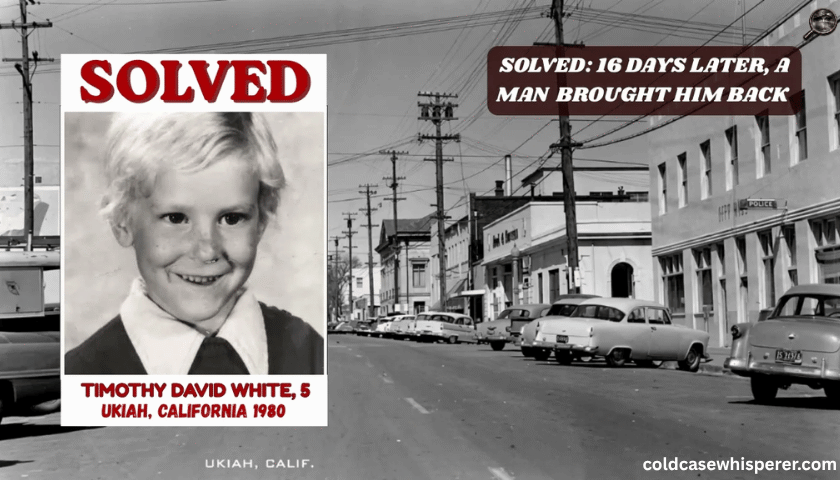
Timothy White Kidnapping Cold Case: A Kidnapping Answered by an Unlikely Rescue
On Valentine’s Day 1980, a five-year-old boy, Timothy White, vanished from a quiet street in Ukiah, California. Sixteen days later, he was found not by a search party or a tip line, but by another kidnapping victim who had been missing for seven years.
The Timothy White kidnapping remains one of the strangest and most human stories in American crime history, not because of how it started, but because of how it ended.
Background
Ukiah sits in Mendocino County, about 120 miles north of San Francisco, a small city surrounded by vineyards and redwood-covered hills. In February 1980, it was the kind of place where a five-year-old could play outside his own house without anyone thinking twice about it.
Timothy White, a kindergartner with sandy hair, lived there with his family and did exactly that. The man who would take him, Kenneth Eugene Parnell, had been working toward this moment for years. Parnell had a long criminal record stretching back to 1951, when he was convicted of raping a young boy after impersonating a police officer to lure him.
He served time, was released, reoffended, and by the early 1970s was drifting through California with an unshakeable compulsion to build a “family” out of a kidnapped child.
On December 4, 1972, Parnell got his chance. With the help of an acquaintance named Ervin Edward Murphy, who approached the boy under the pretense of collecting church donations, Parnell abducted seven-year-old Steven Stayner from a street in Merced, California.
He took the boy to a cabin and, for the next seven years, held him under the name “Dennis Parnell,” moving him through a string of small towns along the Mendocino coast, including Santa Rosa, Comptche, and Point Arena, and enrolling him in local schools each time under the same false identity.
Steven was repeatedly molested during these years and conditioned to see Parnell as a father figure, even as he understood, more and more as he got older, that something about his life was deeply wrong.
By 1980, Steven was fourteen, and Parnell had lost interest in him. A teenager no longer fit the fantasy Parnell was chasing. He began looking for a younger boy. He tried to use Steven to help him find one, but Steven, according to his own later account, deliberately botched every attempt, unwilling to condemn another child to what he had endured.
Frustrated, Parnell turned instead to a local teenager named Sean Poorman, an acquaintance of Steven’s, whom he bribed with money and drugs to help him find a target.
Timothy White Kidnapping
On February 14, 1980, Poorman spotted five-year-old Timothy White playing outside his family’s home in Ukiah. According to accounts of the case, when White resisted, Poorman forced him against a fence and dragged him into Parnell’s waiting car.
Parnell took the boy to a small, one-room cabin near Manchester, on the Mendocino coast, roughly forty miles from Ukiah. There, he cut and dyed Timothy’s hair, the same grooming tactic he had used on Steven years earlier, and began trying to convince the boy that his name was now “Tommy.”
For the next two weeks, Timothy White was held in that cabin. Steven Stayner, still living under Parnell’s control, was tasked with looking after the younger boy. What followed was something neither Parnell nor anyone else could have anticipated.
Steven looked at Timothy and saw his own childhood being repeated in front of him. The guilt and fear that had kept him compliant for seven years started to give way to something else.
The Investigation
Timothy White’s disappearance triggered an immediate response in Ukiah. Police canvassed the neighborhood, volunteers searched nearby fields and creek beds, and the FBI was brought in because of the possibility the boy had been taken across state lines.
His photograph circulated throughout Northern California. But there were no witnesses, no ransom demand, and no physical evidence. For two weeks, the case sat cold, the kind of silence that tends to settle over a small town after a child vanishes without a trace.
What investigators in Ukiah didn’t know was that the boy they were searching for was less than an hour’s drive away, and that the key to finding him was another missing child nobody was actively looking for anymore, because his case was seven years old and long since gone quiet.
ALSO READ – The Buckskin Girl: How DNA Solved & Identified the Marcia King Cold Case
The Break
By late February, Steven had learned that Parnell was planning to move again, likely out of state, taking Timothy with him. Steven had lived through Parnell’s pattern of relocating whenever suspicion started to build, and he understood that once they left California, the chance to get Timothy home might disappear for good. He decided to act.
On the night of March 1, 1980, Parnell left the cabin for his night shift job as a clerk at a local motel. Steven waited until he was sure his captor was gone, then carried Timothy out into the dark and started walking.
The two hitchhiked roughly forty miles down the coast highway toward Ukiah, catching a ride partway with a stranger willing to help two boys out on a cold, rainy night. Once in Ukiah, the boys tried to find someone who could help.
Timothy directed the driver to a babysitter’s house, but no one was home. Unable to recall his own address, Timothy couldn’t lead them to his family directly. Steven found a phone booth, looked up the address of the local police department, and the two of them made their way there on foot.
At the station, Timothy got scared at the last moment and ran back toward Steven, but an officer had already noticed the two boys and brought them inside. When asked who they were, Timothy was quickly identified from the missing-child posters that had been circulating for two weeks.
Steven’s story took longer to piece together. He gave the officers a birth date he wasn’t fully certain of and said he believed his last name was Stayner, a name that meant nothing to the Ukiah police but that, once checked against records from Merced, cracked the case wide open. He had been missing for almost seven and a half years.
Watch the full story unfold in our narrated case breakdown: Timothy White Kidnapping, Cold Case Solved: Stolen, Then Saved | California, 1980 | True Crime
Where the Case Stands
Word reached Merced within hours. Steven’s parents, Delbert and Kay Stayner, who had never stopped hoping their son was alive, learned that he was not only alive but had walked into a police station carrying another kidnapped child in his arms.
Officers were dispatched to the cabin near Manchester and arrested Parnell at the motel where he worked, in the early hours of March 2, 1980. He initially denied any wrongdoing, but the physical evidence at the cabin and the boys’ matching accounts left little room for doubt.
Parnell was tried separately for the two kidnappings. In 1981, he was convicted on both counts. He was sentenced to seven years in prison for kidnapping Timothy White and seven months for kidnapping Steven Stayner, the sentences to run concurrently.
He was paroled in 1985 after serving five years, a fact that drew significant public anger given the scope of what he had done. Because sexual abuse charges were not part of the prosecution, and the statute of limitations complicated some of the older allegations, kidnapping was the crime that stuck.
Steven Stayner returned to Merced and tried to build a normal life. He married Jody Edmondson in 1985, had two children, and largely avoided the spotlight after the trial ended, though the case would later be dramatized in the 1989 television film “I Know My First Name Is Steven,” which aired to a national audience just months before his death.
In September 1989, Steven was killed in a motorcycle accident in Merced. He was twenty-four. Timothy White went home to Ukiah and grew up largely out of the media’s eye. He later became a sheriff’s deputy with the Los Angeles County Sheriff’s Department, based in Newhall, married a woman named Dena, and had two children.
On April 1, 2010, he died suddenly of a pulmonary embolism at the age of thirty-five. Kenneth Parnell did not stop. In 2004, at seventy-two years old, he was arrested in Berkeley after attempting to buy a four-year-old boy from the child’s caregiver for five hundred dollars.
Under California’s three-strikes law, he was sentenced in 2005 to twenty-five years to life. He died in prison at the California Medical Facility in Vacaville on January 21, 2008, at age seventy-six.
The Stayner family’s story did not end with Steven’s death. In 1999, his older brother, Cary Stayner, was arrested and later convicted for the murders of four women near Yosemite National Park, a case entirely separate from the kidnapping but one that reshaped how the family’s name was remembered.
Cary received the death penalty in California and a federal life sentence, and remains incarcerated. Steven’s father, Delbert Stayner, died at his home in Winton, California, on April 9, 2013.
The case left a physical mark on both towns. In Ukiah, residents later commissioned a bronze statue depicting the teenage Stayner leading young Timothy to safety, intended as a symbol of hope for families still searching for missing children.
In Merced, when the city later asked residents to suggest names for a new park honoring hometown figures, Stayner’s family proposed naming it after Steven. City officials ultimately chose someone else, reportedly out of concern that the name would call to mind Cary’s crimes instead of Steven’s rescue of a five-year-old boy he had never met before that February night.
The Timothy White kidnapping is remembered today less for what Parnell did than for what a fourteen-year-old boy chose to do despite everything Parnell had done to him. Steven Stayner had every reason to think only of his own escape. Instead, he carried a five-year-old stranger down a dark highway in the rain and gave him back to his family.
Sources
This account draws on contemporary news coverage of the case from United Press International and Time magazine (1980 to 1981), trial and sentencing reporting from Parnell’s 1981 kidnapping convictions.
Biographical documentation of Kenneth Parnell, Steven Stayner, Cary Stayner, and Timothy White compiled from public records and later journalistic retrospectives on the case and the Stayner family.
For the full narrated version of this case, told documentary-style, visit the Cold Case Whisperer YouTube channel.
2 comments