
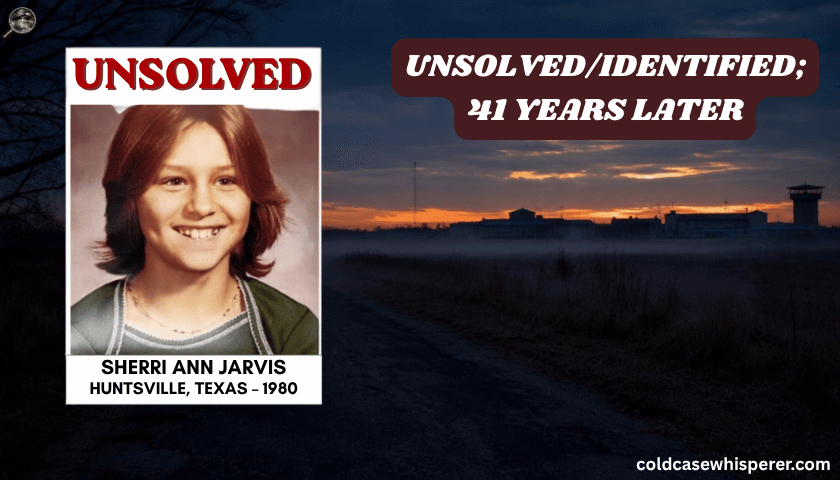
Sherri Jarvis Case: Unsolved Cold Case, A Nameless Girl on a Texas Road
On the morning of November 1, 1980, a truck driver spotted a body lying about twenty feet off the shoulder of Interstate 45, just north of Huntsville, Texas.
The girl had no identification, no belongings, and no name investigators could attach to her. For the next forty-one years, she was buried under a headstone that read only “unknown white female.”
The Sherri Jarvis case would remain unsolved in the most basic sense possible, without even knowing who the victim was, until forensic genetic genealogy finally gave her back her identity in 2021. Her killer has never been found.
Background
Sherri Ann Jarvis was born on March 9, 1966, in Stillwater, Minnesota. Friends knew her as “Tati.” She was about five feet six inches tall inches, with brown hair and brown eyes, and was remembered by those who knew her as street-smart, outgoing, and intelligent.
At thirteen, Minnesota authorities removed her from her family’s home because of habitual truancy, and she was placed in state custody. In a statement released after her identification, her family said she had promised in a letter to return home.
She never did. Her parents both died in the decades before she was found, never knowing what became of their daughter.
Sometime in early 1980, Sherri ran away from the agency that had custody of her. The last contact her family had was a letter postmarked from Denver, Colorado. What happened between that point and October 1980 remains unknown.
Minnesota’s records from the case have since been purged, and investigators have never been able to reconstruct exactly how a fourteen-year-old girl from a Minneapolis suburb ended up more than a thousand miles away in East Texas.
The Sherri Jarvis Case Begins
On October 31, 1980, Halloween night, Sherri arrived alone in Huntsville, Texas, a small city about seventy miles north of Houston best known for housing several units of the Texas prison system, including the Ellis Unit and the state’s execution facility.
Witnesses at a gas station and at the nearby Hitchin’ Post Truck Stop reported seeing a teenage girl asking for directions to the Ellis Unit, a state prison farm on the edge of town. She told people she was from Rockport, Texas, and said she had a friend at the prison she needed to see. She was last seen wearing blue jeans and a white sweater.
The following morning, November 1, a truck driver found her body on the shoulder of Interstate 45. She had been sexually assaulted and killed by ligature strangulation, according to Sheriff Clint McRae. Aside from a gold chain with a smoky blue rectangular pendant, she was found without clothing, though a pair of red high heels were recovered nearby.
Investigators searched for any connection to the prison, showing her photograph to inmates and staff at the Ellis Unit and contacting authorities in Rockport to see if anyone recognized her.
No one did. The friend she claimed to be visiting was never identified, and prison staff had no record of her entering the facility that evening, which left investigators without a clear picture of what happened between the moment she was last seen walking toward the prison gate and the discovery of her body the next morning.
With no fingerprint match and no missing person report that lined up with her description, she was buried in Oakwood Cemetery in Huntsville under a marker reading “unknown white female, died Nov. 1, 1980,” known from then on to investigators only as the Walker County Jane Doe.
ALSO READ: 👉 Alicia Showalter Reynolds: An Unsolved Cold Case on Route 29, Culpeper, Virginia
The Investigation
For nearly two decades, the Walker County Jane Doe case sat largely dormant, revisited periodically but without new leads. In 1999, her body was exhumed so investigators could collect a DNA sample using STR and mitochondrial DNA testing, methods that were still relatively new to forensic science at the time.
The profile was entered into available databases, but no match was found. Forensic artists with the National Center for Missing and Exploited Children produced facial reconstructions in both 2012 and 2015, hoping a rendering of her face might jog someone’s memory.
Neither effort produced a viable lead. Her case was entered into the National Missing and Unidentified Persons System as case number UP4630, and by the time it drew local television coverage again in 2015, she had already been Walker County’s oldest unidentified homicide victim for thirty-five years.
The investigation regained momentum that year, when Walker County Sheriff’s Office Detective Thomas Bean was assigned to the file.
Local television station ABC13 in Houston covered the case that November under the headline asking whether detectives could identify the unknown girl found dead thirty-five years earlier, part of a broader effort to keep her story in front of the public.
Bean worked the case for years afterward, and in July 2020 the sheriff’s office contracted Othram Inc., a Texas laboratory based in The Woodlands that describes itself as the first lab built specifically to apply whole-genome sequencing to forensic investigations, to attempt a new DNA extraction from the old evidence.
Othram’s scientists built a more complete genetic profile than earlier testing had allowed and uploaded it to genealogy databases used for law enforcement searches. The technique, known as forensic or investigative genetic genealogy, works differently than a standard DNA match against a criminal database.
Rather than searching for an exact match to a known offender, genealogists look for people who share partial DNA segments with the unknown sample, typically distant cousins who have submitted their own DNA to consumer genealogy sites for family history research.
From there, they build out a family tree, working forward and backward through generations of public records, obituaries, and census data, narrowing the field of relatives until they can identify a specific branch of the family the DNA likely belongs to.
The same broad method had gained national attention a few years earlier when it was used to identify the Golden State Killer, and it has since been applied to hundreds of unidentified remains and unsolved crime cases across the country.
By March 2021, genealogists had identified six people they believed were likely direct relatives, possibly parents, siblings, or aunts and uncles, of the unidentified girl.
Detective Bean cross-referenced that information against public records and social media and eventually located Sherri’s siblings, who confirmed they had a missing family member matching her description. Additional DNA testing on fresh samples from the family confirmed the match by late September 2021.
Watch the Full Story Unfold in Our Narrated Case Breakdown & Subscribe Too:
👇👇
Where the Case Stands
On November 9, 2021, Walker County Sheriff Clint McRae announced at a press conference that the Walker County Jane Doe had been identified as Sherri Ann Jarvis. It was one of the first publicly announced Texas cases resolved using Othram’s identity inference process.
Her family released a statement through the sheriff’s office thanking investigators, noting that they had once contacted the Salvation Army and hired a private investigator in an unsuccessful attempt to find her while she was still missing.
She is survived by a sister. In their statement, the family described more than four decades of not knowing, and said they were relieved that Sherri had finally been found.
Even with her name restored, the person responsible for her murder has never been identified. No suspect has been publicly named, and the case remains open.
The same forensic genealogy technique that identified Sherri has not yet produced a viable lead on her killer, since the male DNA needed for that kind of search has not been isolated from the evidence collected in 1980. Investigators have said they continue to hope that advances in DNA technology, the same kind that finally gave Sherri her name, might eventually do the same for the person who killed her.
At the time Sherri went missing in 1980, before national databases for missing children existed and before jurisdictions routinely shared information across state lines, her family’s search options were limited.
Relatives have said they reached out to the Salvation Army’s missing persons program and paid for a private investigator, neither of which turned up any trace of her.
That gap between a missing person report filed in Minnesota and an unidentified body found in Texas is part of what allowed her case to remain unsolved for so long, since the two records were never connected until DNA made the link undeniable.
The marker at Oakwood Cemetery that once read only “unknown white female” has since been updated to bear her real name. Sherri Ann Jarvis is no longer the Walker County Jane Doe. She is a fourteen-year-old girl from Stillwater, Minnesota, whose murder is still waiting to be solved.
Her case also became something of a milestone for Texas law enforcement. As one of the first cases in the state publicly resolved through Othram’s identity inference process, it demonstrated to other agencies working unidentified remains cases that decades-old DNA, degraded and limited as it often is, could still be coaxed into revealing a name when paired with modern genome sequencing and genealogical research.
Detectives who had inherited cold cases with little hope of resolution took notice, and the technique has since been applied to a growing number of Texas’s long-unidentified victims.
Anyone with information about the murder of Sherri Ann Jarvis is asked to contact the Walker County Sheriff’s Office at (936) 435-2400.
Sources
This account draws on reporting from the Walker County Sheriff’s Office press conference and public statements (November 2021), contemporaneous coverage from ABC13 Houston, KBTX, KSTP, and CBS Minnesota, a detailed account published by Texas Monthly, and case background compiled by DNASolves and the National Missing and Unidentified Persons System.
For the full narrated version of this case, told documentary-style, visit the Cold Case Whisperer YouTube channel.
One comment