
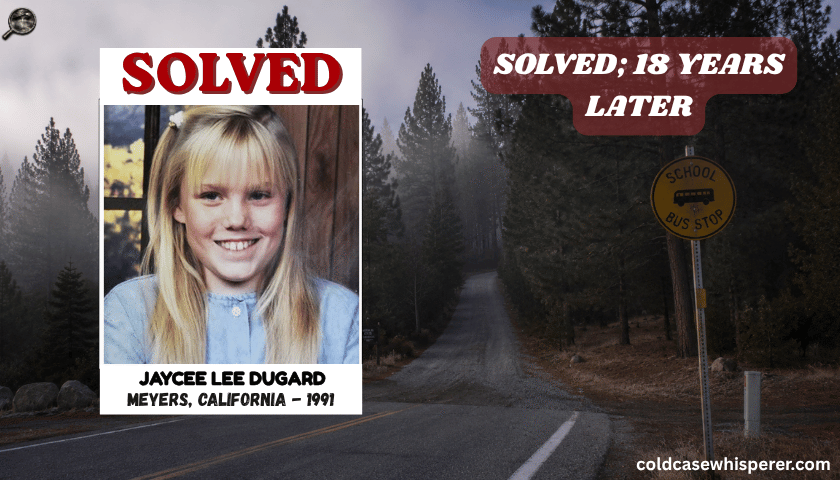
The Jaycee Dugard Kidnapping Solved Case in 1991
The Jaycee Dugard kidnapping case stands as one of the longest documented child abduction cases in American history, an eighteen-year disappearance that ended not through a forensic breakthrough.
but through the instincts of two university police employees who noticed that something about a father and his two daughters did not add up.
Jaycee Lee Dugard was eleven years old when she was pulled off a road in Meyers, California, on her way to a school bus stop in June 1991. She would not be found alive and identified again until August 2009, less than two hundred miles away, in a hidden backyard compound in Antioch, California.
Background
Jaycee Lee Dugard was born on May 3, 1980, in Arcadia, California. Her mother, Terry Probyn, had separated from Jaycee’s biological father when Jaycee was young, and by the time Jaycee reached elementary school, Terry had built a new family life with her partner, Carl Probyn.
The family settled in Meyers, a small mountain community just south of South Lake Tahoe in El Dorado County. Jaycee attended Meyers Elementary School and was, by all accounts, an affectionate and outgoing child with a love of drawing and animals, interests that would resurface decades later in her recovery and advocacy work as an adult.
The man who would take her, Phillip Garrido, had a documented history of extreme violence well before 1991. In 1976, he abducted a twenty-five-year-old woman named Katie Callaway from a South Lake Tahoe parking lot, drove her to a storage unit in Reno, Nevada, and raped her repeatedly.
A police officer noticed the storage unit’s lock hanging open and interrupted the assault, leading to Garrido’s arrest. Callaway later testified against him, and her account of the attack became part of the official record used decades later to argue that Garrido had never stopped being a danger to the public.
He was convicted in federal court of kidnapping and sexual assault and received a fifty-year federal sentence along with a life sentence in Nevada state prison. Under the parole rules in effect at the time, he became eligible for release far earlier than those sentences suggested.
While incarcerated at the federal penitentiary in Leavenworth, Kansas, Garrido corresponded with a woman named Nancy Bocanegra, whom he married in a prison ceremony in 1981.
When he was paroled in 1988 after serving roughly eleven years, he moved into Nancy’s home in Antioch, a Contra Costa County suburb east of San Francisco, where he remained under lifetime federal parole supervision on paper.
By his own later admissions, Garrido had struggled for years with drug abuse and had developed elaborate religious delusions that he used to justify his behavior to himself and eventually to Jaycee. Federal parole rules required regular home visits and, at times, GPS monitoring, oversight that was meant to make a repeat offense virtually impossible.
ALSO READ – Mary Stauffer Kidnapping: Solved Cold Case, 53 Days Trapped in Minnesota, 1980
The Abduction
On the morning of June 10, 1991, Jaycee dressed for school and walked up the driveway toward the school bus stop on Washoan Boulevard while her stepfather, Carl Probyn, watched from the kitchen window. A gray two-door sedan pulled up near her, a woman reached out and grabbed her, and Jaycee was pulled inside before the car sped off.
Carl ran after the vehicle on foot but could not catch it or read the license plate, and a neighbor who heard the commotion gave chase on a bicycle before losing the car on the winding mountain roads. He called 911 at 8:19 a.m.
The El Dorado County Sheriff’s Department launched an immediate search, questioning known sex offenders, searching remote cabins in the Sierra Nevada, and pursuing thousands of leads with help from the FBI, but despite the scale of the effort, the trail went cold within weeks.
Jaycee had, in reality, been taken directly to the Garrido property in Antioch, where Phillip Garrido, with Nancy’s assistance, had built a concealed network of tents, soundproofed sheds, and locked enclosures behind the main house at 1554 Walnut Avenue, hidden from the street by a tall fence and overgrown trees.
Eighteen Years in Captivity
Jaycee was held in that backyard compound for the next eighteen years. She was given the name Alissa and isolated from any outside contact, with no schooling, television, or way to verify anything her captors told her.
In 1994, when she was fourteen, she gave birth to her first daughter, delivered by Nancy Garrido in the compound with no medical professional present. A second daughter followed in 1997, also born without any outside medical care.
Phillip Garrido publicly presented himself as a reformed, born-again businessman running a small printing operation, and beginning in the 2000s he took the two girls out in public with increasing frequency, introducing them to neighbors and acquaintances as his children.
Jaycee herself was rarely seen, and when she did appear alongside Garrido, it was always under close watch and always using her assigned name.
Neither of her daughters was ever enrolled in school, taken to a doctor, or issued a birth certificate during those years, and both grew up knowing no life beyond the fenced enclosure and Garrido’s control.
There were missed chances to end the Jaycee Dugard kidnapping case years earlier. In 2006, a neighbor called the Contra Costa County Sheriff’s Office to report children living in tents in the Garridos’ backyard. A deputy responded, got no answer at the front door, walked the perimeter without entering the yard, and left without following up.
Deputies returned to the property again in 2008 on a separate complaint, again without uncovering the hidden compound.
Meanwhile, Garrido’s federal parole officer conducted repeated home visits over the years but never thoroughly searched the property or questioned the presence of two young girls living with a registered sex offender under lifetime supervision.
Terry appeared on local television in the following weeks, holding up a photograph of her daughter and appealing to anyone with information to come forward, but no credible sighting ever materialized during those first months.
Watch the Full Story Unfold in Our Narrated Case Breakdown & Subscribe Too:
👇👇
The Break in the Case
The case finally broke open on August 24, 2009, when Phillip Garrido visited the campus of the University of California, Berkeley, with his two daughters, then eleven and fifteen, seeking a permit to hold a religious event.
He met with Lisa Campbell, manager of the UC Berkeley Police Department’s special events unit, who found his manner erratic and was unsettled by the girls, who stood silent and expressionless and were introduced with the names Angel and Starlet.
Campbell shared her concerns with fellow campus police officer Ally Jacobs, who ran a background check on Garrido and discovered he was a registered sex offender on lifetime federal parole for the 1976 kidnapping and rape conviction.
Jacobs contacted Garrido’s parole officer, Edward Santos Jr., who had no record that Garrido had any children living with him. That mismatch set off a chain of events that neither officer could have predicted.
Santos instructed Garrido to report to the parole office in Concord, California, on August 26, 2009, and to bring the two girls with him. When Garrido arrived, officials separated the girls from him and began asking gentle but persistent questions.
Under continued questioning, Garrido eventually admitted that the girls’ mother was a woman he had “obtained” years earlier from South Lake Tahoe. Investigators were dispatched to the Walnut Avenue property, where they found the hidden compound of tents and sheds concealed behind the main house.
A woman living inside identified herself first as Alissa, then, after a pause, confirmed she was Jaycee Dugard, a moment that ended an eighteen-year search in the span of a single sentence.
Trial and Sentencing
Phillip and Nancy Garrido were charged with kidnapping, forcible rape, lewd acts upon a minor, and false imprisonment, a combined indictment that eventually totaled 29 felony counts between them.
Because the crimes involved violations of federal parole as well as state charges, both state and federal jurisdiction applied, but the case was resolved entirely in California state court to spare Jaycee and her daughters multiple trials.
On April 28, 2011, Phillip Garrido pleaded guilty to kidnapping and multiple counts of sexual assault, and Nancy Garrido pleaded guilty to kidnapping and aiding her husband’s crimes. Phillip Garrido was sentenced to 431 years to life in prison. Nancy Garrido was sentenced to 36 years to life. Both remain in California state custody.
Where the Case Stands
The failures that allowed Garrido to hold Jaycee for eighteen years under the nose of a supervising parole system prompted a formal state investigation.
In 2010, the California Office of the Inspector General released a report documenting missed home visits, failure to search the property, and repeated failure to verify the identities of the children in Garrido’s home, describing a pattern of institutional neglect spanning nearly two decades.
Later that year, the State of California approved a twenty million dollar settlement to Jaycee Dugard in acknowledgment of that failure. California lawmakers subsequently passed reforms tightening parole supervision requirements for high-risk sex offenders, including mandatory unannounced home visits with full property searches.
Jaycee Dugard has since built a private life away from public attention, settling in an undisclosed location with her mother and daughters. She was also reunited with her biological father in the months after her rescue, a relationship that had been essentially nonexistent since before her birth, and she gained a half-sister she had never known.
In 2011 she published a memoir, “A Stolen Life,” followed in 2016 by “Freedom: My Book of Firsts.” She founded the JAYC Foundation, which supports families recovering from abduction and trauma through therapy and advocacy work, including equine and nature-based programs.
Lisa Campbell and Ally Jacobs, the two UC Berkeley police employees whose attentiveness ended the Jaycee Dugard case, were publicly recognized for their role in the investigation, including an appearance together on national television weeks after the rescue.
The house at 1554 Walnut Avenue was condemned and later demolished, and the lot where it once stood was eventually redeveloped by the city of Antioch.
For the full narrated version of this story, visit the Cold Case Whisperer YouTube channel.