
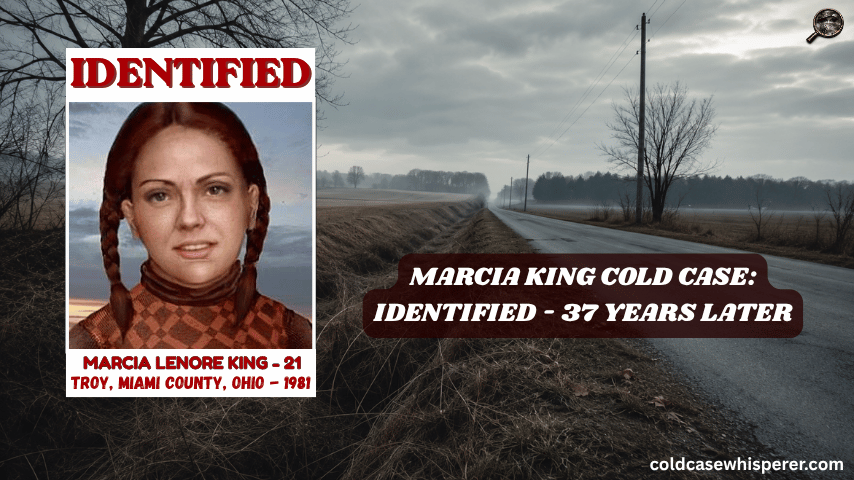
Marcia King Cold Case: Thirty-Seven Years Without a Name
For thirty-seven years, she had no name. She was known only by what she wore: a handmade, fringed buckskin jacket found on her body along a rural Ohio road in April 1981. Investigators, reporters, and the public came to call her the Buckskin Girl.
The Marcia King cold case would eventually become one of the clearest examples of how forensic genetic genealogy can succeed where fingerprints, dental records, and decades of conventional police work cannot. Her killer, however, remains unidentified.
Background
Marcia Lenore Sossoman was born on June 9, 1959, in Little Rock, Arkansas. She later went by the surname King, taken from her mother’s second husband, who adopted her as a child. Little is documented about her early life beyond a few consistent points.
She left school before graduating, gave birth to a daughter who was placed for adoption, and drifted away from close contact with her family sometime in her late teens or early twenties.
Relatives later described her as someone who moved often and kept in touch only sporadically, which was not unusual enough at the time to prompt alarm.
The last confirmed contact her family had with her was in late 1980. After that, communication stopped. Because Marcia was an adult with a documented pattern of moving between states and going quiet for stretches, no missing person report was filed. Her family believed she had simply moved on again, as she had before, and that she would eventually resurface.
That assumption, understandable at the time, became one of the central obstacles investigators faced for the next thirty-seven years. Without a missing person report anywhere in the country, there was no active file for law enforcement to cross-reference against the unidentified body found in Ohio.
Marcia existed, for investigative purposes, only as a set of physical details and the clothes she was found in. What later forensic work would suggest, based on isotope analysis of her remains, is that isotope evidence pointed toward the northeastern United States, possibly Canada, rather than the region where she was born and had likely been moving frequently in the months leading up to it.
Combined with the rodeo patch sewn onto her jacket, this pointed toward a transient life that intersected with rodeo circuits, truck stops, and highway travel, a lifestyle common enough at the time that a young woman moving through it could pass through many towns without leaving an official record behind.
On the morning of April 24, 1981, a passing motorist found a young woman’s body in a drainage ditch along Greenlee Road, a rural road in Miami County, Ohio, near the city of Troy.
She had been dead for an estimated one to two days. She was white, approximately 5-foot-6 and 125 pounds, with brown hair and hazel eyes. She had suffered blunt force trauma and had been strangled with a ligature; the county coroner ruled strangulation the cause of death.
Defensive wounds on her hands and arms indicated she had fought her attacker. There was no evidence of sexual assault, and she carried no identification of any kind.
What she wore became the case’s defining detail. Over a red turtleneck, blue jeans, and handmade deerskin moccasins, she wore a full-length, fringed buckskin jacket, laced up the front. On one hand was a silver ring set with a turquoise stone. Sewn onto the jacket was a souvenir patch from the 1979 National High School Rodeo Finals.
Investigators contacted the rodeo association hoping someone would recognize her, but the patches had been sold and traded widely at the event and led nowhere. The name “Buckskin Girl” followed from the jacket, and it was the only identity she had for decades.
ALSO READ – The Timothy White Kidnapping Solved Cold Case: Rescued by a Fellow Captive
The Investigation
The Miami County Sheriff’s Office pursued the case using every tool available at the time. Fingerprints were compared against national records. Dental charts were distributed to law enforcement agencies. Missing person bulletins were checked against her description across all fifty states. Nothing matched.
An autopsy noted a horizontal scar on her lower abdomen, consistent with a prior cesarean section or similar surgery, indicating she had given birth before her death. This detail added a piece to her story without adding a name: somewhere, a child existed who might never know what happened to her birth mother.
She was buried at Riverside Cemetery in Troy, Ohio, under a headstone that read only “Buckskin Girl.” The grave was maintained for years by community members who had no personal connection to her but had followed her story in local news, a small but consistent gesture that kept her case visible even as the leads dried up.
The file did not sit untouched. Investigators periodically revisited it as new forensic methods became available.
DNA profiles were developed from evidence in 2001 through the Miami Valley Regional Crime Lab, and again in 2009 through a lab at the University of North Texas, and entered into CODIS, the FBI’s national Combined DNA Index System.
Neither effort returned a match. The DNA that ultimately identified her in 2018 came from a blood sample that had been kept in storage since 1981. Later forensic work included isotope analysis, a technique that examines chemical signatures locked into bone, teeth, and hair to estimate where a person lived during different periods of their life.
The results pointed toward the northeastern United States or possibly Canada, a finding that complicated rather than confirmed the rodeo circuit theory and suggested a transient lifestyle in the months before her death.
The analysis could not pin down a location precisely, but it supported the working theory that she had traveled widely and recently before she was killed.
In 2016, the sheriff’s office released an updated forensic facial reconstruction, a digital rendering built from her skull structure and estimated features. It was circulated through news outlets and social media, generating a new wave of public tips. Investigators followed up on each one. None led to an identification.
Throughout this period, her case was listed with national unidentified persons resources, including databases used to cross-reference unidentified remains against missing person reports from across the country. Because no missing person report existed for Marcia anywhere in the system, those cross-references never produced a match, no matter how many times the case was reviewed.
The jacket, the patch, and the reconstructed face were, for thirty-six years, the only tools available to connect her to a name. By 2017, the case had gone unsolved for thirty-six years, one of the longest-standing unidentified-person cases in Ohio and one of the more visible ones nationally due to the jacket’s distinctiveness.
The Marcia King cold case, still known publicly only as the Buckskin Girl at that point, had outlasted multiple rounds of new forensic technology without yielding a name.
Watch the full story unfold in our narrated case breakdown: The Buckskin Girl Cold Case: Identified After 37 Years | Marcia King | True Crime (1981, Troy, Ohio)
The Break
In 2017, the Miami County Sheriff’s Office was approached by the DNA Doe Project, a nonprofit founded by genetic genealogists Margaret Press and Colleen Fitzpatrick. The organization proposed applying forensic genetic genealogy to the case, a method that had not yet been used to identify a decades-old unidentified homicide victim anywhere in the country.
The approach involved sequencing DNA from her remains into a format compatible with public genealogy databases such as GEDmatch, then using the same research techniques adoptees and amateur genealogists use to trace family trees: working backward from distant genetic matches toward a shared ancestor, then forward again toward living relatives who might lead to a name.
Funding for the sequencing work was raised through donations, and the resulting data file was uploaded to GEDmatch in late 2017. Volunteer genealogists, working largely on their own time, began building out extended family trees from the matches the database returned.
Most of these matches were distant, in the range of fourth and fifth cousins, meaning the shared ancestry could be a century or more removed. The work relied on census records, obituaries, marriage licenses, and public records to connect scattered names into a coherent family structure, then narrow that structure down by age, sex, and known movement patterns until a plausible candidate emerged.
By early 2018, the genealogists had traced a family line rooted in Arkansas and identified a woman born in 1959 whose documented history stopped around 1980: Marcia Lenore King.
The Miami County Sheriff’s Office contacted a woman in Arkansas identified as Marcia’s sister. Marcia’s mother and sister agreed to provide DNA samples for direct comparison. The results confirmed what the genealogists had found: the Buckskin Girl was Marcia Lenore King.
On April 11, 2018, the Miami County Sheriff’s Office held a press conference in Troy, Ohio, and announced the identification to the public. It was one of the first times forensic genetic genealogy had been used to identify a previously unidentified homicide victim, a method that has since been applied to numerous other unidentified persons and cold cases across the country.
The Marcia King Cold Case
The identification gave Marcia’s family confirmation of what had happened to her after decades of not knowing. A new headstone bearing her full name and her dates of birth and death was placed at Riverside Cemetery. The original marker reading “Buckskin Girl” was not removed; it remains in place beside the new one, a record of the thirty-seven years she spent unnamed.
Marcia’s daughter, the child she had placed for adoption years before her death, was located and informed of the identification following the 2018 announcement. Details of that reunion have not been made public, and this account does not speculate beyond what has been confirmed: that she was found and notified.
In Troy, a city that had followed the Buckskin Girl story for nearly four decades, the identification closed one long-open question even as it left the larger one unanswered. Community members who had maintained her grave for years now had a name to attach to the flowers they left.
The case remains a point of local memory in Miami County, tied closely to the broader recognition that forensic genetic genealogy, once a tool used mainly by hobbyist genealogists and adoptees searching for biological relatives, had become a viable method for solving cases law enforcement had exhausted by conventional means.
Marcia King’s killer has not been identified. The Miami County Sheriff’s Office has stated that the case remains an open, active homicide investigation. Physical evidence collected from the original crime scene, including the ligature and clothing, has reportedly been preserved, and investigators have indicated they are open to applying forensic genetic genealogy to crime-scene evidence if a usable DNA profile can eventually be developed.
The same approach that identified Marcia herself. No timeline has been given for that work, and no suspect has been publicly named.
The passage of more than four decades presents real obstacles. Witnesses from 1981 have aged or died, and the transient world Marcia moved through- truck stops, rodeo circuits, and highway travel was difficult to trace even at the time, let alone now.
Still, the identification itself gave investigators a name, a birthplace, and a documented set of movements to work from, which is considerably more than the case had for its first thirty-seven years. The Marcia King cold case is no longer a question of who she was. It is now, and remains, a question of who killed her.
Anyone with information about Marcia King’s murder can contact Chief Deputy Steve Lord at the Miami County Sheriff’s Office, (937) 440-3980, or the office’s general line at (937) 440-6085.
The Marcia King case is frequently cited within the genetic genealogy field as an early proof of concept, the kind of case that showed investigators and the public what was possible when DNA sequencing was paired with traditional genealogical research.
For Miami County, it also reframed a case that had been treated for decades as an identification problem into what it had always actually been underneath: an unsolved murder waiting for its own forensic breakthrough.
Sources
- Miami County Sheriff’s Office case records and public statements
- DNA Doe Project case documentation and public statements
- Press conference announcing identification, Troy, Ohio, April 11, 2018
- Contemporary and retrospective news coverage of the Buckskin Girl case
- Riverside Cemetery (Troy, Ohio) records
For the full narrated version of this case, visit the Cold Case Whisperer YouTube channel.
При поиске качественных ссылок часто используется база трастовых сайтов для хрумера.